
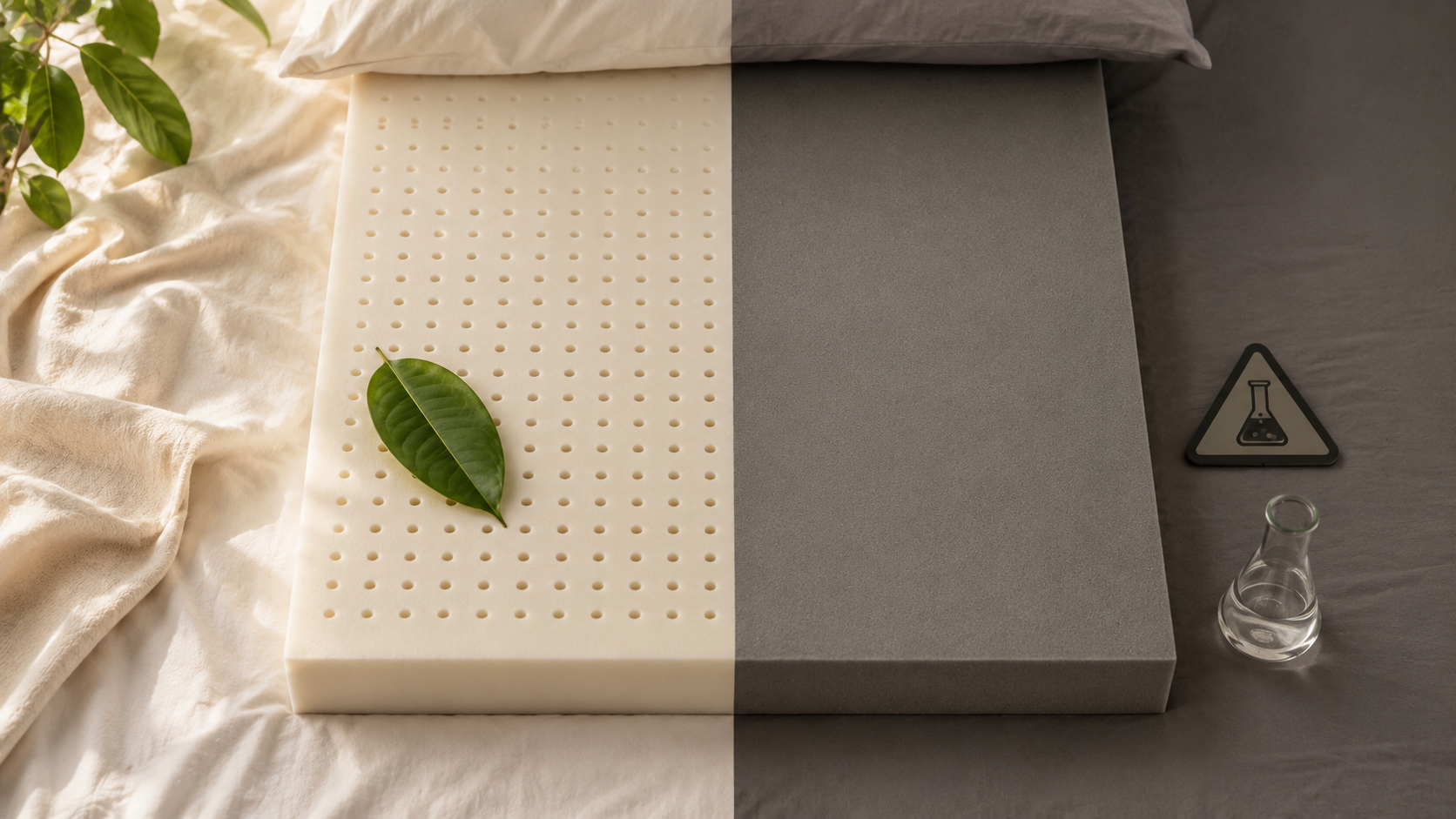
Most people have no idea what’s inside their mattress. Once you find out, you can’t unsee it — and you’ll understand why your sleep has felt the way it has.
You obsess over what goes into your body — organic produce, filtered water, clean-label supplements. But every night, for eight hours, you press your face and body against a surface made of materials you’ve never once thought to question.
The bedroom is the last room in the average Indian home to receive the “clean living” treatment. We search food labels and skincare ingredients but accept whatever a mattress salesperson tells us without a second thought. Yet we spend more continuous time in contact with our mattress than with almost any food or product we consume.
🧪
If you care about what's in your food, you should care about what's in your mattress. Share this with someone who's into clean living — they've probably never thought about this.
First, What Is Your Mattress Actually Made Of?
Walk into any mid-range mattress store in India and the labels will use words like “premium foam“, “orthopaedic support“, “cooling gel layer“, and “memory technology.” These sound like features. They are, in fact, descriptions of synthetic petroleum-derived materials.
The dominant material in roughly 80% of mass-market mattresses sold today is polyurethane foam — a plastic polymer made from crude oil derivatives. Memory foam is a variant of this. Gel foam is polyurethane with gel beads suspended in it. Rebonded foam — the cheap core material in many budget mattresses — is made from shredded synthetic foam scraps compressed together.
None of this is secret. It’s just never explained to the buyer.
| 80% of mass-market mattresses are made primarily from synthetic polyurethane foam | 61 different chemical compounds detected in off-gassing tests of new synthetic foam mattresses | ⅓ of your life is spent in direct contact with your sleep surface — more than any other material |
The Off-Gassing Problem Nobody Warns You About
When you bring a new synthetic mattress home and notice that distinctive chemical smell, you’re experiencing off-gassing — the release of volatile organic compounds (VOCs) from the materials inside your mattress into the air of your bedroom.
The smell usually fades after a few days. The off-gassing does not. It continues at lower, undetectable levels for months — sometimes years. You’re breathing this air for 7–9 hours every night, in a relatively enclosed space (your bedroom), while your body is in its most receptive, regenerative state.
The Chemical Cocktail in a Typical Synthetic Mattress
Studies have identified a range of compounds in synthetic foam off-gassing. These are not present in trace amounts — they're structural components of the material itself, releasing gradually over years of use in your sleep environment.
A study by the Environmental Working Group (EWG) found that new polyurethane foam mattresses emit dozens of VOCs including known carcinogens and respiratory irritants. Children and infants — who sleep longer and breathe at a lower height — are considered especially vulnerable to these emissions.
This is not an argument against synthetic materials in all contexts. It’s an argument for knowing what you’re choosing when that material is your sleep surface — the place your lungs operate in a state of maximum openness for one third of your life.
What Natural Materials Actually Are?
Natural sleep materials — primarily natural latex, organic cotton, and natural wool — come from biological sources and are processed without petroleum-derived chemicals. They have been used as sleep surfaces for centuries, long before synthetic alternatives existed.
Natural latex deserves particular attention because it’s the most technically sophisticated of the natural sleep materials and the most directly comparable to synthetic foam in terms of its function — support, contouring, and pressure relief.
It comes from the rubber tree (Hevea brasiliensis) — a milky sap that is harvested, aerated, and baked into a resilient open-cell foam without the need for petroleum-based binding agents or synthetic fire retardants. The resulting material is chemically inert, breathable, durable, and biodegradable.
| Performance Factor | 🌿 Natural Latex | 🧪 Synthetic Foam |
| Temperature Regulation | Actively breathable — open-cell structure allows continuous airflow. Sleeps cool naturally. | Traps heat — designed to conform by absorbing warmth. Hot sleepers’ nightmare. |
| Spinal Support | Responds to body weight dynamically — supports lumbar curve without sagging over time. | Adequate initially. Compresses in high-pressure zones (hips, shoulders) within years. |
| Durability | 10–20 year lifespan with consistent support. Doesn’t develop permanent body impressions | 3–7 year functional lifespan before noticeable support degradation. |
| Allergen Resistance | Naturally antimicrobial and dust mite resistant — latex proteins repel colonisation. | Warm, moisture-retaining environment. Dust mites thrive. Allergy risk increases with age. |
| Chemical Safety | Zero VOC off-gassing when certified natural. No synthetic flame retardants needed. | Ongoing VOC emission. Requires chemical fire retardants. No mandatory disclosure. |
| Environmental Impact | Renewable, sustainably harvested, fully biodegradable. Carbon-sequestering rubber trees. | Petroleum-derived, non-biodegradable. Significant manufacturing carbon footprint. |
The Clean Living Blind Spot
Here’s the paradox: the clean living movement has transformed how Indians shop for food, skincare, and baby products. Organic produce sections are expanding. “No parabens, no sulphates” is now a mainstream expectation for shampoo. Parents read ingredient lists on baby formula with forensic intensity.
But we buy mattresses based on price, firmness, and the confidence of a sales pitch.
This isn’t hypocrisy — it’s a blind spot. The mattress industry has never been asked to communicate its materials the way food and cosmetics industries have. There’s no equivalent of the FSSAI label for sleep products in India. Buyers simply don’t know what they don’t know.
Indoor air quality in bedrooms — where we spend more time than any other room — is typically 2–5x more polluted than outdoor air, according to EPA research. Off-gassing from furniture, mattresses, and synthetic materials is a primary contributor. Ventilation, material choice, and surface upgrading are the most effective interventions.

Dreamzee 100% Natural Latex Topper
Replace your synthetic sleep surface without replacing your mattress. Natural latex on top changes everything.
Myths the Synthetic Mattress Industry Relies On
1. Memory foam is the best material for back support.
Memory foam conforms to the body by softening under heat — which feels good initially but creates uneven sinkage over time, particularly under heavier zones like hips. Natural latex responds to pressure dynamically and springs back — providing adaptive support that doesn't worsen with temperature.
2. The chemical smell disappears after a few days — it's harmless.
The smell disappears. The off-gassing continues at lower concentrations. Multiple peer-reviewed studies have detected VOC emissions from synthetic foam mattresses months after purchase. The absence of a smell is not the absence of emission.
3. Natural latex is just a premium marketing term — it's basically the same thing.
100% natural latex (GOLS certified) is chemically and structurally distinct from synthetic latex (SBR foam) and polyurethane foam. It has a different molecular structure, different breathability profile, different durability curve, and no petroleum origin. They are genuinely different materials — not marketing variants of the same product.
4. Going natural means replacing your whole mattress — it's too expensive.
The top layer of your sleep system — the 2–4 inches your body actually contacts — determines most of the heat, support, and chemical exposure you experience. A natural latex topper placed on your existing mattress replaces that top layer entirely, transforming your sleep surface without a full mattress overhaul.
What About Your Pillow?
The same material logic applies entirely to your pillow — arguably even more so, because your pillow is centimetres from your nose and mouth for the entire night. It’s the surface your airways are closest to throughout every breath of every sleep cycle.
A synthetic pillow — polyester fill, shredded memory foam, or microfibre — traps heat around your head, compresses unevenly under the weight of your skull, and presents the same off-gassing profile as any other synthetic sleep material. A natural latex pillow maintains its loft consistently, allows airflow, resists dust mites, and stays dimensionally stable throughout its lifespan.
The average person breathes approximately 17,000 times during a night of sleep. The air composition immediately around your pillow — its off-gassing profile, dust mite load, and humidity level — is what your respiratory system processes with every single one of those breaths.
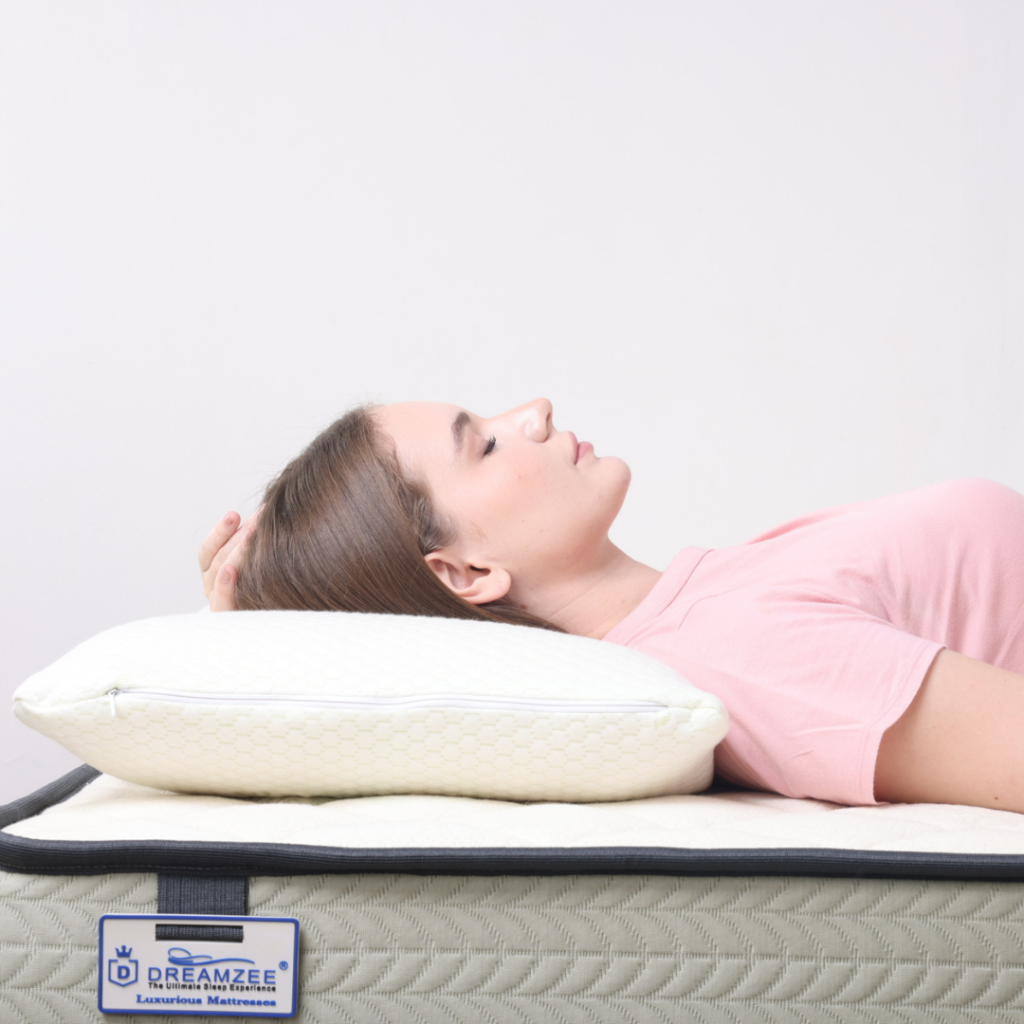
Dreamzee Natural Latex Pillow
No synthetic fill. No off-gassing. Just natural latex that breathes, supports & stays cleans – night after night.
The Simple Shift That Changes Everything
You don’t need to change your entire bedroom to begin sleeping on natural materials. The most impactful single change — the one that affects temperature regulation, chemical exposure, allergen load, and spinal support simultaneously — is your sleep surface.
Start with what your body contacts directly. A 100% natural latex topper changes the material equation of your existing bed entirely. Pair it with a natural latex pillow, and the air your lungs process all night is cleaner, cooler, and free from the chemical profile of synthetic alternatives.
This is what the clean living movement looks like inside the bedroom. And once you make the switch, you’ll wonder why it took you this long.

Leave a Reply