
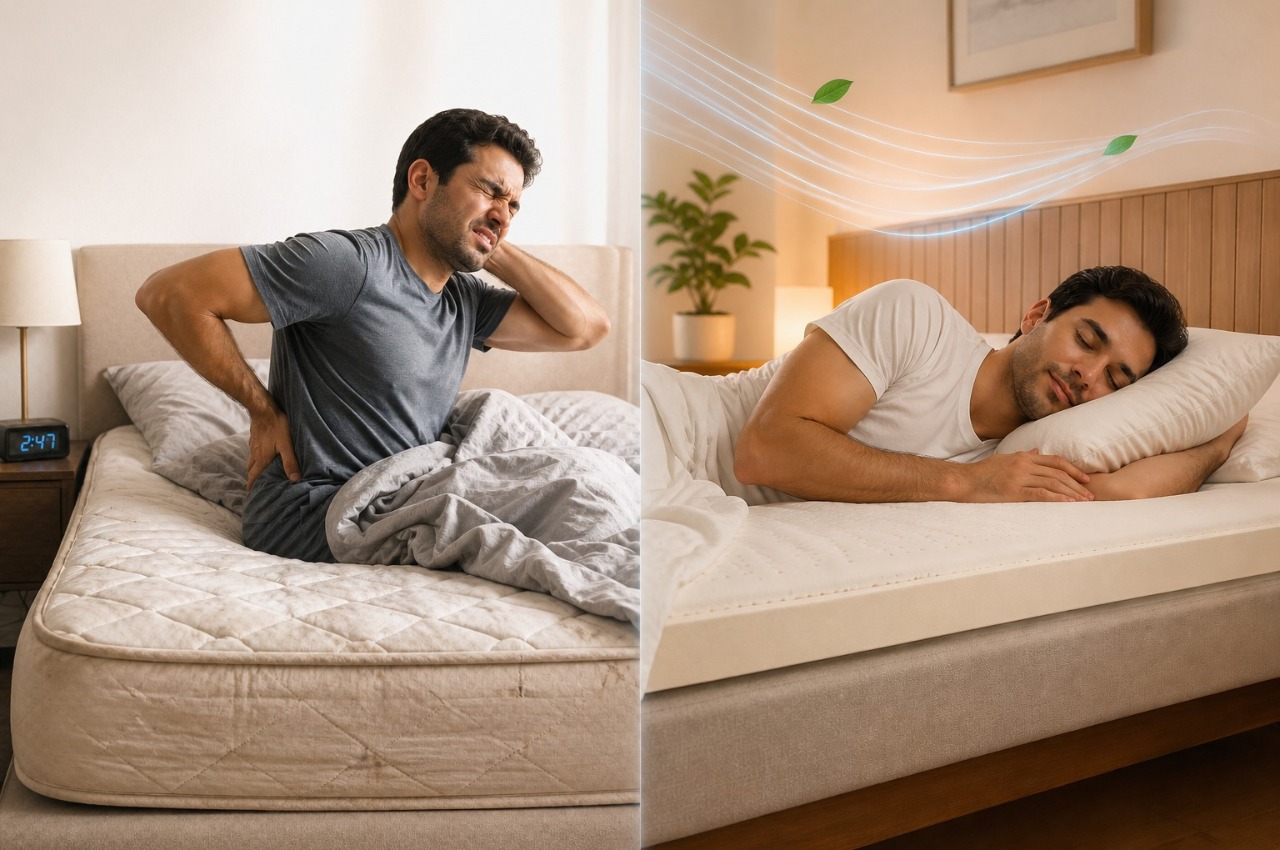
You wake up. Your alarm hasn’t gone off yet, but you’re already awake — stiff lower back, neck that feels like it was bent the wrong way all night, a vague fog behind your eyes. You tell yourself it’s stress. It’s age. It’s just how mornings feel.
But what if it’s none of those things?
What if the problem is the thing you’re sleeping on?
93% of people who report “poor sleep” have never considered their mattress as the cause — blaming stress, diet, or screens instead. The mattress industry has quietly let us forget that sleep surfaces degrade, compress, and become toxic over time.
We spend an average of 26 years of our lives in bed. Yet most of us replace our phones every 2 years and our mattresses every… never. Or whenever it becomes embarrassingly lumpy. The irony is brutal: we obsess over sleep hygiene — no screens after 9pm, chamomile tea, sleep trackers — while ignoring the most obvious variable of all.
What Your Mattress Is Actually Doing to You at Night
Sleep isn’t passive. Your body is doing extraordinary work — clearing brain waste, repairing muscle tissue, regulating hormones, consolidating memory. For all of that to happen, your spine needs to be in neutral alignment, your pressure points need relief, and your temperature needs to stay regulated.
A mattress — or a mattress that’s past its prime — can sabotage all three simultaneously.
| 🌡️ Sleeping Hot Memory foam traps body heat, raising core temperature and disrupting REM sleep cycles. | 📍 Pressure Points Hard or worn-out surfaces press into hips and shoulders, cutting off circulation overnight. | 🔄 Partner Disturbance Motion transfer from one side wakes the other, fragmenting sleep without you realising it. |
| 🧠 Morning Fog Disrupted deep sleep stages leave you groggy even after 8 hours — the mattress paradox. | 💨 Off-Gassing Chemicals Synthetic foams release VOCs — volatile organic compounds — into the air you breathe all night. | 🦠 Dust Mite Buildup After 5 years, up to 10% of a mattress’s weight can be dead skin and dust mites. The stuff of nightmares. |
“Your body knows something is wrong. You just keep blaming everything except the one surface your body rests on for a third of your entire life.”
The 5 Mistakes 93% of Sleepers Make (Without Knowing It)
| Keeping a mattress for 10+ years The average mattress loses 20-30% of its support structure within 5-7 years. By year 10, you’re essentially sleeping on a flattened surface that no longer responds to your body’s contours. Most people don’t notice the gradual degradation — it happens one night at a time. |
| Confusing “firmness” with “support” Firm does not mean supportive. A hard mattress pushes back uniformly against your body — ignoring the fact that your spine is curved, not straight. True support means the surface adapts to you, not the other way around. |
| Ignoring what the mattress is made of Synthetic polyurethane foam is in roughly 80% of mass-market mattresses. It’s cheap to produce, but it off-gasses chemicals, retains heat, and collapses far faster than natural materials. Most buyers never think to ask what’s actually inside. |
| Blaming everything else first Sleep apps. Blue light glasses. Melatonin. Weighted blankets. All of these are sold to people who haven’t considered that the foundation itself might be broken. It’s like buying premium fuel for a car with flat tyres. |
| Assuming a new mattress means an expensive mattress Many people delay replacing a poor sleep surface because they think a fix requires a full mattress replacement — a ₹30,000–₹80,000 investment. But the sleep surface problem can often be resolved for a fraction of that cost, if you know what to target. |
🔬 What the Research Says
A 2009 study published in the Journal of Chiropractic Medicine found that new bedding systems significantly reduced back pain and improved sleep quality in participants. A separate Oklahoma State University study found that newer mattress surfaces reduced back discomfort by 57% and improved sleep quality by 60%. The surface matters — enormously.
How to Know If Your Mattress Is the Problem
There’s a simple test. When you sleep in a hotel — even a mid-range one — do you wake up feeling better? Do you sleep through the night more often? Do you spring out of bed instead of creaking out of it?
If yes, your mattress at home is likely the culprit.
Other tell-tale signs your sleep surface has become your worst enemy:
You can feel the springs or can see visible sagging
Any visible dip or compression in your mattress is your body sinking into a structurally compromised surface — not support.
You wake up stiff but feel better after moving around for 30 minutes
Morning stiffness that fades with movement is a classic sign of overnight compression and poor spinal alignment — not arthritis or age.
You’re waking up in the night more often than you used to
Increased sleep fragmentation — waking at 2am, at 4am — is often linked to discomfort signals your body is sending that you’re not consciously registering.
Your mattress is over 7 years old
Full stop. The materials inside have degraded beyond their optimal range. The question isn’t if it’s affecting your sleep — it’s how much.
The Smarter Fix Nobody Talks About
Here’s something the mattress industry doesn’t want you to know: you don’t always need to replace your entire mattress to reclaim your sleep.
The sleep surface — the top layer your body actually contacts — is responsible for the majority of how a mattress feels. Temperature regulation, pressure relief, spinal support: all of this is primarily determined by the top 2–4 inches of your sleep system.
This is why the concept of a mattress topper exists. And not just any topper — the material of that top layer changes everything.
Synthetic toppers (polyester fill, memory foam) solve the immediate comfort problem but introduce new ones: they trap heat, flatten within months, and add the same chemical concerns as the mattress beneath them.

That’s exactly where Dreamzee Natural Latex Toppers come in — designed to fix heat, pressure, and support issues without replacing your entire mattress.” Available in Soft & Hard Comfort options
The material that sleep scientists, orthopaedic specialists, and natural living advocates keep returning to is one that’s been used for centuries — not because it’s trendy, but because it genuinely performs differently than anything synthetic can replicate.
“The question isn’t whether your sleep surface affects your health. It’s whether you’re going to keep waiting for the problem to solve itself — or take control of the one thing you do for 8 hours every single day.”
What to Do Right Now?
Start with awareness. Tonight, before you fall asleep, pay attention: Is your back resting comfortably, or are you shifting to find a position? Are you warm before you even fall asleep? Is your neck supported naturally, or are you propping it with a stacked pillow?
These aren’t small discomforts. They’re your body communicating. And unlike stress or screen time, the sleep surface is a variable you can actually change — without changing your entire bedroom or spending a fortune.
The next step is understanding what that change should look like — and why the material at the centre of it matters more than almost anything else you’ll choose for your bedroom.

Leave a Reply